
UCAN is releasing a Request for Proposals (RFP) to obtain a vendor of liquid dairy products for its Head Start and Preschool Promise Programs. Proposals will be accepted up to 4:00pm, August 24, 2026. UCAN would prefer to have a vendor that can distribute products directly to its school sites, but will also consider proposals from vendors who are only able to deliver dairy to its kitchen at 284 NE Kenneth Ford Drive, Roseburg, Oregon. Materials for the RFP are found below. Those submitting Proposals must complete Form 1 (the application), Form 2 (pricing spreadsheet) and be prepared to enter into the contract attached as Form 3 if selected. Questions about this RFP can be sent to Christopher Johnson at christopher.johnson@ucancap.org.
Category: News
WAITING LIST FOR UCAN AFFORDABLE HOUSING UNITS NOW OPEN
UCAN’s FY24 Annual Report and 2025 Community Needs Assessment are now available
Fill the Barrel, Feed the Community!
Celebrating the Retirement of UCAN CEO Shaun Pritchard
Governor Recognizes Head Start Programs
Letter from the CEO
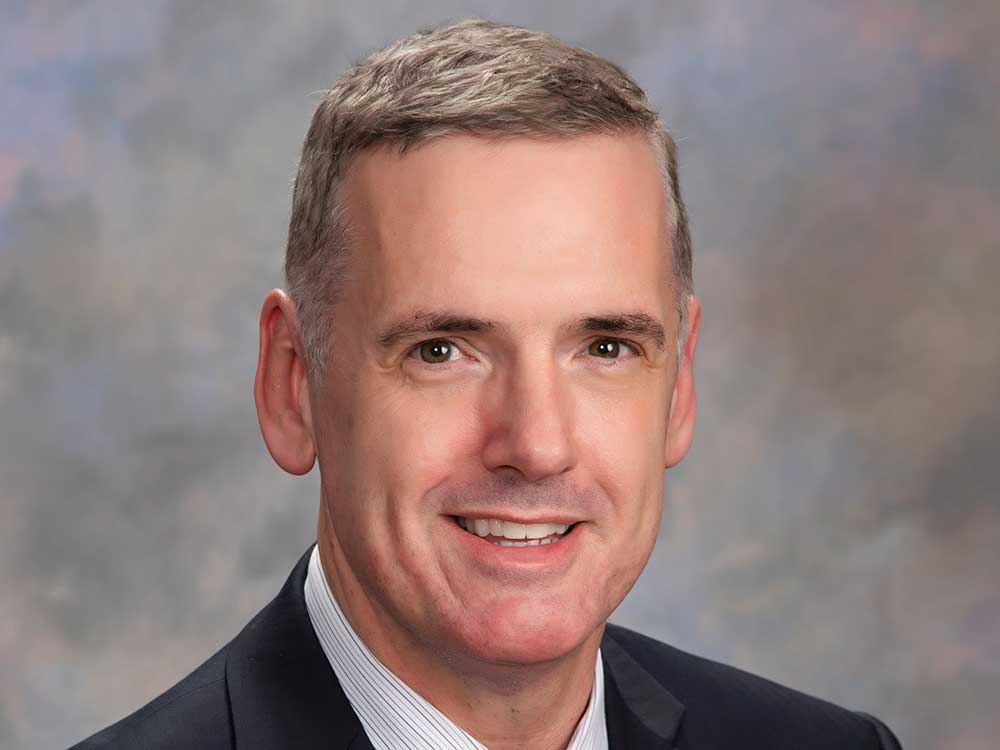
I want to start by thanking my dedicated Homeless and Housing staff for the incredible work they have done, and continue to do, this year. We know that housing and homelessness are still big problems in our community-we explain why in the article on homelessness. But we have been able to help so many people stay housed, find new housing, and as needed, find shelter.
In the past several months, we’ve launched two new initiatives that both address health issues that contribute to poverty. Our new Healthy Homes program will help hundreds of individuals breathe more easily when wildfires send toxic ash and particulates to their homes. We look forward to offering air purifiers and filters to folks qualifying for weatherization services.
In partnership with Umpqua Health, AllCare and the Oregon Health Authority, we are just beginning to provide a range of social services to residents on Medicaid. These services, like those keeping people housed, will reduce both individuals’ needs for health services and chronic health conditions that burden our communities. We are using funds made available to support this effort to integrate all services offered by UCAN and other partners, making it simpler for people to “get the right service at the right time.”
We are offering a great opportunity for partner agencies to increase their capacity by hosting AmeriCorps members. I am an enthusiastic supporter of AmeriCorps, as it develops a workforce that benefits our communities. We have seen many of our AmeriCorps alumni stay in our area after completing their service. We all benefit from the passion they bring to their service.
And we are again hosting a Cheese and Thank You event in Douglas County to raise funds for our regional food bank, Feeding Umpqua. The event runs the entire month of March. While we’ll receive donations for each item purchased, local residents will not only enjoy local eateries’ innovations on grilled cheese and other cheesy treats, but will also have chances to win some great prizes.
We are seeing less outside support for food purchases right now, while the need for emergency food is at record levels. So we’re hoping for a record level of cheese eaters. And if you can’t or don’t eat cheese, please consider a donation to Feeding Umpqua. As our team at Feeding Umpqua says: “You’ll be doing a world of Gouda!”
Say Cheese and Raise Funds for Feeding Umpqua
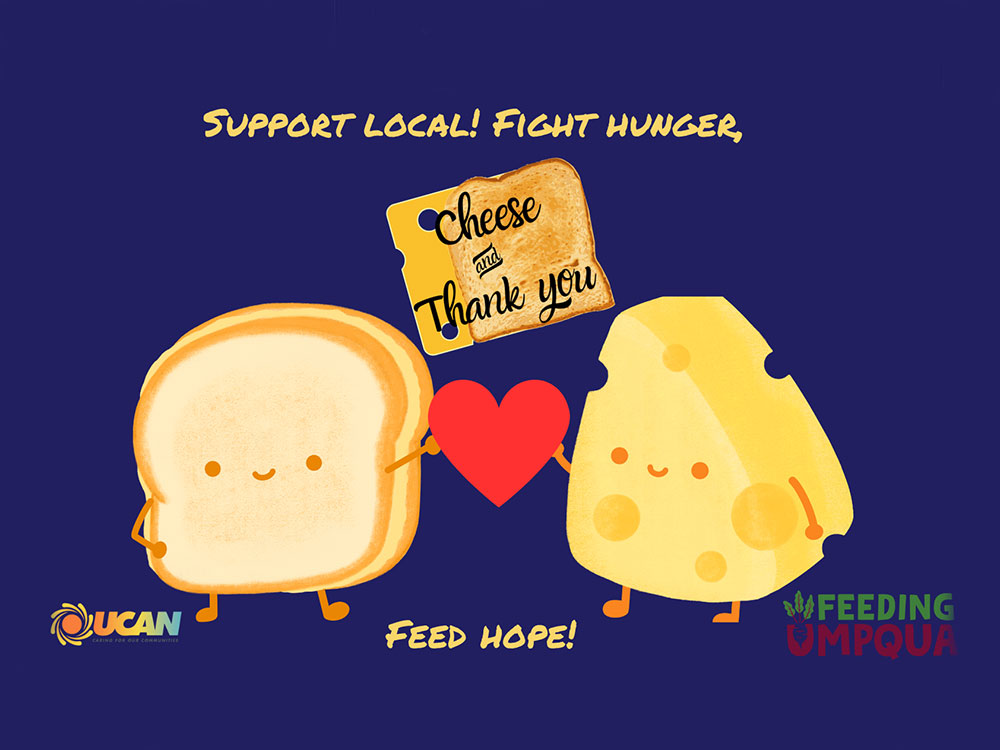
Once again, Feeding Umpqua has organized a fun, gooey event to help address hunger in Douglas County. You can take part in Cheese and Thank You by purchasing a cheesy creation made special by one of a number of our participating establishments. For every item purchased, our partners will donate $2 to Feeding Umpqua. We also have major sponsors helping to support the event, including Umpqua Bank (our “Sharp Cheddar” sponsor), Keller Lumber (“Mozzarella” sponsor), Umpqua Health (Monterey Jack) and KMTR (media sponsor).
We will kick-off our month of gooey delight on Saturday, March 1st from 10am-2pm at Umpqua Bank’s downtown Roseburg branch (445 SE Main Street). Bring your family and enjoy free cheesy bites. We will also have booths set up for fun activities, including crafts and games for the little ones. You can pick up your Cheese and Thank You passport here as well.
If you can’t make it to the event, no worries. You can pick up a passport at any participating eatery. Gather stamps at each location you purchase a cheesy treat! At the end of the event, you can return your passports to our office at 280 Kenneth Ford Drive in Roseburg or at any participating restaurant, and we will offer prizes to some lucky cheese heads.
Participating locations are found throughout Douglas County and include:
- Brix
- Atom Bistro & Coffee Bar
- Backside Brewery
- Coho Pizza
- Creekside Gas & Grill
- Granny’s Mini Hut
- Jackson Street Provisions
- Kelly’s Cozy Corner
- La Cocina
- Little Brother’s Pub
- North Forty Beer Company
- Serendipity
- The Soup & Salad Shop
- Sweet Confections
- The Friendly Kitchen / Meals On Wheels
- The Pizza Bus
- Tuck’s Place
- Urban NY Pizza & Grill
- Wine Destination
- Winston Midtown Grill
And if you can’t eat dairy, consider donating directly to Feeding Umpqua. Now more than ever, we are depending on local support to purchase foods to address local hunger.
UCAN Starts Offering New Medicaid Benefit

Oregon has received a waiver from the federal government to pilot Medicaid benefits that can address health related social needs (HRSN). HRSN’s, such as housing, shape people’s lives from birth onward, and they wield far-reaching influence over health outcomes, surpassing the significance of clinical care. Through its waiver, Oregon not only is working to innovate ways to better address health issues, but also to ensure that folks whose lives are in transition are eligible for more comprehensive care.

Those on Oregon’s Medicaid program (OHP) may be eligible for the added benefits if they are:
- Released from incarceration in the past 12 months
- Discharged from an institution for mental disease in the past 12 months
- Currently or previously involved in the Oregon child welfare system
- Transitioning from Medicaid-only to dual eligibility (Medicaid and Medicare) status within the next three months or has transitioned in the past nine months
- Homeless or at risk of becoming homeless.
Individuals also need to be experiencing a health issue that the benefit will address. Some benefits have additional requirements, e.g., rent assistance is only available to those with a signed lease.
Local Coordinated Care Organizations (CCOs) (networks of providers serving OHP members) are standing up the new benefit locally by contracting with social service providers. UCAN has entered into contracts with both AllCare in Josephine County and Umpqua Health in Douglas County to receive certain referrals for the new benefit. UCAN has also entered into an agreement with the Oregon Health Authority to serve local residents who are not members of their local CCO.
Individuals must first apply to their CCO or the Oregon Health Authority, as appropriate, and have them authorize the service. Once approved, we receive the referral (we are not authorized to approve applications). We have just started receiving our first HRSN referrals (from Umpqua Health). These initial referrals are for home modification and home remediation services. We are currently able to offer installation of ramps, grab bars, pull-down drawers, window blinds, as well as home cleaning and pest control.
In the near future, we will begin helping local residents complete HRSN applications. We also expect to receive referrals for other services, such as rent and utility assistance and tenancy support. Jordan Jungwirth, UCAN’s Chief Operating Officer applauds the State for moving forward with the expanded Medicaid benefit, sharing that “these benefits are a welcome addition to services we already offer to thousands of local residents.”
UCAN Launches New Program Improving Indoor Air Quality

Summers have been changing in our part of Oregon. Wildfires are on the increase. Since 2020, our region has experienced four wildfires near or exceeding 100,000 acres, including the Archie Creek (125,000 acres), Slater (157,000 acres), Jack and Devil’s Knob (100,000 acres), and the Smith River North Complex (95,107 acres) conflagrations.
We often think that once flames are out, the danger from these fires is over. But this is not the case. Smoke and residue from these fires, which can last long after fire fighters stop the spread of flames, have components that themselves are dangerous to human health. Fires that simply burn forests still create smoke filled with materials such as formaldehyde. If buildings, cars, and other man-made objects burn, smoke and ash can fill with asbestos, heavy metals and other noxious substances.
Moreover, particles found in smoke, regardless of their nature, worsen health. These particles affect the body’s ability to remove viruses and bacteria from the lungs, leaving us more vulnerable to numerous diseases and infections. Short-term exposure (i.e., days to weeks) to particles from smoke worsen existing respiratory and cardiovascular diseases and even causes people to die prematurely.
For those of us with A/C units or room air purifiers, much of the ash and residue suspended in smoke can be captured in filters. But folks lacking A/C or air purifiers are left with little choice but to breathe in soot and smoke that fill their home. On days when outdoor air quality indices hit levels at which we are warned to stay indoors, these individuals cannot escape the damage done to their health by smoke. Distressed health in turn deepens poverty, and is one of the more common reasons people become poor.
UCAN has launched a Healthy Homes program to help low-income residents avoid the exposure to indoor smoke and ash and the associated health impacts. UCAN is leveraging our expertise in home weatherization to do so. Those eligible to have their homes weatherized will now also be eligible to receive an air purifier along with high quality air filters. The air filters can reduce indoor air particles by over 90%.
The Oregon Health Authority is providing grant funds for three years to operate our Healthy Homes program. We hope that at the end of this period, we will again be able to obtain funding to enhance this service. Long-time Douglas County resident Heather King, UCAN’s Supportive Services Director, proclaims, “Nobody should have to sit in a smoke-filled home, inhaling toxins and struggling to breathe.”